
Yeitse

DNA1

This post was inspired by Michael Eisen (@mbeisen), who innocently asked about the DNA content of various foods on Twitter a few days ago. As expected, the responses were mostly the rantings of idiots, all sound and fury, signifying nothing. Michael Eisen also brought my attention to a recent Oklahoma State University survey that returned the surprising result that 80% of Americans don’t understand the difference between DNA itself and genetically engineered DNA. Although, there’s some debate about the veracity of the survey, as Ben Lillie (@BenLillie) points out that previous research doesn’t back the claim that Americans are so dense, but I’ve shown before that survey design can alter the outcome.

Due to this cacophony, I remembered an old post I’d abandoned about eggs, or yeitse. (Yeitse is the Russian word for egg. It helps if there is one cool fact that you can take home from any blog post. 🙂 In it, I noted that eggs are virtually DNA-free. So I spruced up the old text and hope that Michael will find it more informative than the usual 140 character Twitter snark.

An egg weighs about 57 grams and contains 213 milligrams of cholesterol. It is about 80% water, and the rest of the weight is evenly split between protein and fat. Eggs have been appreciated as a great source of concentrated nutrients for thousands of years, except for perhaps the last 50. It has been proposed that the building of the pyramids was enabled by the prior domestication of the chicken. Chickens permitted the pharaohs to set up massive, mobile protein manufacturing plants (chicken coops) in any area, immediately adjacent to new construction sites, and thus feed the manual laborers that were their primary source of motive power.

Eggs, as I mentioned, are a rich source of cholesterol. Humans first began to badly misunderstand the egg at the same time that they began to associate, but not fully comprehend, cholesterol and atherosclerosis. When they examined the diseased blood vessels of well fed men suffering from heart attacks, they found disgusting, yellowish gobs of material distorting the walls of these vessels. The material was mostly cholesterol. Not recognizing (or perhaps forgetting) that cholesterol makes up about 35% of every membrane in every cell in the body, and that most of the cholesterol in the human is made especially for this purpose by the liver—they decided that eating cholesterol caused heart disease.

So they took an animal that does not normally eat eggs, and they fed them eggs anyway. They also picked an animal that does not make cholesterol in its liver, like people, but gets it by eating plants. This animal, the white rabbit, developed really bad atherosclerosis when overfed with eggs. So forgetting that people are not rabbits, it was announced that atherosclerosis is caused by the eating of eggs. And most people believed it, and tried to stop eating them.

MINOLTA DIGITAL CAMERA

An egg is just a single cell. You tend to forget that, holding one in your hand and tossing it up into the air. If you were holding an onion of about the same size, you would be holding several million cells. There are other differences between an egg and an onion, but one that really stands out is the amount of DNA. It takes about 30 times more DNA to make an onion than a chicken. That is, the chicken genome contains about 1.8 billion bases, but the onion genome contains more than 70 billion. It’s not entirely clear why an onion takes such a detailed instruction manual, while a chicken can be made using an IKEA version. An egg that you buy in the store usually isn’t fertilized, so it contains only one single copy of the chicken genome. Even if the chicken had sex and the egg was fertilized, there would be only two copies. In an onion, you get millions of copies of the onion genome. None of this would really matter, except that about the same time humans began to misunderstand eggs, they also began to get some funny ideas about DNA.

For as long as humans have been eating, they have been eating DNA. Whether from chickens, or onions, or goose liver—if you eat a cell, you eat DNA. Eating the DNA of another organism isn’t dangerous. Since it occurred commonly prior to January 1, 1958, the government considers it to be GRAS—or Generally Recognized As Safe. GRAS is a technical term used by health regulatory officials. It means, literally, that if a substance has been consumed by people for as long as anyone can remember, then it can’t hurt you. Seems like an odd concept, when you think about alcohol, which has a long history of human consumption and isn’t very good for you… but anyway, DNA falls into this category.

Very soon after people began to be fearful that their heart disease was being caused by eggs, they also began to be fearful of eating DNA, but not all DNA, or at least not most of it. They were specifically worried about recombinant DNA. Now, every time an organism reproduces, the DNA recombines, so all DNA is recombinant, by definition. But still, there was DNA out and about starting in the later part of the twentieth century that had been helped to recombine just the way some human scientists wanted it to. This came to be known as genetically modified, or GM. Again, that’s bad terminology, because DNA is constantly being modified. As stable as it is, DNA is continually damaged, cut, and locally annihilated by reactive chemicals and radiation. So all DNA is GM. Some very special DNA is GM at the behest of humans, and the rest is randomly and senselessly GM at the behest of entropy. So the intelligently modified DNA could be called genetically engineered, or GE.

Someone mentioned to me that it might be particularly risky to eat human genes. Jeffrey Dahmer did it. Not to say that makes what he did OK, but I think something altogether different was responsible for his lack of health and sanity. Likewise, there was the Argentine soccer team who got stranded in the Andes and had to eat each other to stay alive. Then again, there are certain sexual practices that culminate in one or the other of the participants getting a mouth full of semen. I think this was already happening in 1958, so it just might be GRAS. Some people swallow, and some don’t. As far as I know, there is no alleged health difference between these groups. What I do know for sure—one swallow like that contains more human DNA and protein than… well, that’s probably enough said about that.

Admittedly, people who eat human genes sometimes die, but I don’t think it is a causal relationship. It seems to me that eating human DNA can be associated with a risk of infectious disease, and a risk of incarceration, depending on how exactly it is done. In talking with people who fear recombinant DNA, it dawned on me that they were not well informed. They do not realize that when they catch a virus, it inserts copies of its own DNA right into theirs. Often, the genes the virus inserts are clever and malevolent, capable of deprogramming their cells and forcing them to make cloned copies of the virus. That’s quite scary, compared to just making a healthy nutrient as in golden rice or other GM,GE improved foods. It turns out that the genes of biotechnology critics are themselves genetically modified and perverted in ways that ought to induce an acute self-loathing. Perhaps it’s not possible to be virulently opposed to molecular biotechnology and still fully educated about the types of DNA modification and gene swapping routinely indulged in by bacteria and viruses, inside your own body, 24/7.

Addendum

I notice the government has chimed in, and they are almost certainly wrong, because plant genomes run 3-50 times bigger than most animal genomes. That is because plants bear a heavy load of parasitic retrotransposons—bits of old jumping DNA, like the ones that make corn colorful.
Posted in Environment, Genetics, Science | Tagged , , | 4 Comments

When is a Survey not a Survey?

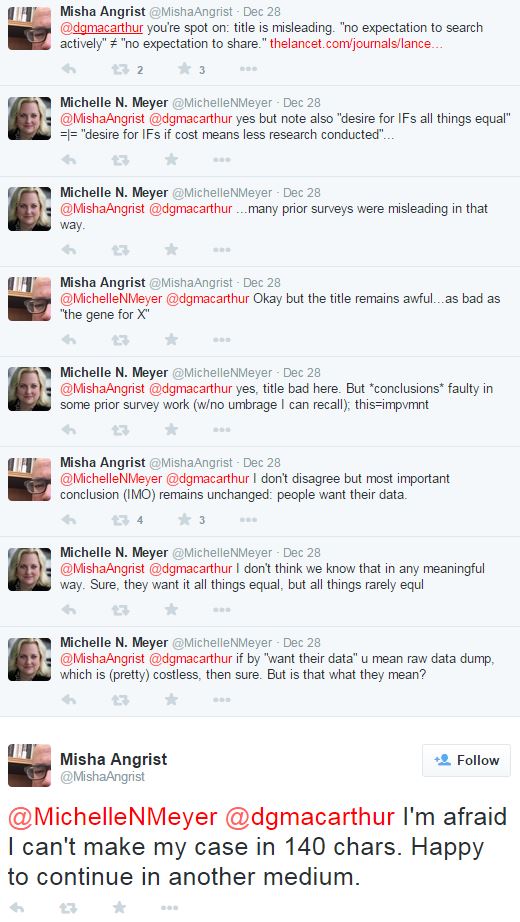
One of the great things about Twitter is that it alerts you to new papers and discussions of those papers that you’d otherwise not be privy to. Sadly, the 140 character limit badly stunts those discussions just when they are really warming to a good topic, as happened here:

Twitter_Conv

Since I found this paper very interesting and applicable to my professional experience and personal experience as a participant in the Personal Genome Project, I read it—and then I personally took the survey on which it was based.

Unfortunately, about 5 minutes into the exercise, I was surprised when the “survey” actively challenged one of my answers. That is, it attempted to caution me that what I was in favor of, and I quote, “…is likely to be very expensive and time consuming. This may mean that the research is compromised.”

Maybe I have some assumptions with respect to the use of scientific surveys that form the basis of publications in peer reviewed journals that are a bit old-fashioned, but it seems obvious to me that this survey instrument is not really a survey at all if it seeks to guide the responder’s choices by 1) supplying added information that may change a response and 2) making claims that suggest there will be negative consequences because of a response.

Imagine for a moment that this survey was about diet and not about the incidental findings of genomics research. And suppose it asked the respondent how many servings of “crisps” (I just love sticking with the very British tone of this thing) they ate? Imagine, if after admitting to eating 8 servings of crisps each day, the survey instrument then prompted, “Eating that amount of crisps is unhealthy and is likely to make you very obese. Are you sure that you really eat that much?” The psychology of this situation is very well understood—a substantial percentage of people will slant their responses in order to seem to be good, normal persons as opposed to bad, unhealthy persons. Or in the case of genomics research, one certainly would try to avoid having an opinion that causes things to become very costly and time consuming, compromising genomics research.

Not only does this survey seek to instruct and then query, but I question very much the accuracy of the information it provides. There is free software available on the internet that can easily be used to call every SNP in the human genome. Or more to the point, to identify every known disease-associated mutation in the Online Mendelian Inheritance in Man (OMIM) which will supply more than 10,000 possible incidental findings. It is actually NOT very costly or time consuming to supply this information to each participant in a genomics research study, and a system could be established to automatically deliver boilerplate explanations and followup recommendations for these disease associated mutations, which brings us to the really relevant point of this all.

Any participant, in almost any medical research study of any kind, is going to receive a hands-on physical examination by a physician. This exercise is as old and stereotypical of anything in medicine today. Such an examination certainly has costs, but we recognize those as essential costs of conducting proper medicine and patient care. Further, we would never have a discussion as to whether any abnormalities that were unexpectedly observed during that exam should be shared with the patient—of course they should be shared. Those that seem to have some risk should be actively followed up.

Examining a patient’s genome is not really any different—it is simply a matter of volume. While a physical exam could return perhaps 100 findings, a genomic exam will return tens of thousands. By quickly sieving those through the available software mentioned earlier, it is not costly or burdensome to supply the patient with a brief written summary of what is known about the genetic findings that have been made, ranked in their order of importance or actionability. The idea that a genomics researcher could just decide not to do that is very irresponsible. But then, so is constructing a survey that seems to actively go fishing for a set of opinions that will justify this lazy attitude that there is no expectation on the part of the patient to ever be told this information either.

It is my experience that patients want to be told every important medical observation that could have an impact on their health and well being. The fact that this may need to be presented on a CD—that’s just how it is with genomic medicine.

Posted in Uncategorized | Leave a comment

Re: Will a return of rising temperatures validate the climate models?

Instability is the first thing that one will notice if presented with climate data, on almost any scale. That is why the flat-line in global surface air temperature that began in 1998 is so unexpected. The debate over climate change is largely partisan, unscientific, acrimonious, and unyielding to moderation. But both sides in this political trench warfare seem to quietly admit that this stability cannot last, and that they’d better be prepared with spin pre-packaged when it comes undone.

From the perspective of alarmists, the longer we go without managing even 0.01 °C of warming, the further off their “drop dead limit” of 2° C gets. So predictably, a comment recently appeared in Nature written by David Victor and Charles Kennel (PDF) urging everyone to just forget about that 2° C thing. Like hurricanes that fail to appear and sea levels that don’t rise, surface air temperature is losing favor as a motivational factor. Climate alarmists are now searching for a “thing” to keep fighting, even if their main thing, which is warming, drops out on them.

In the other camp, climate realists are also taken somewhat aback by the duration of this stability, and readily admit that surface air temperature can’t be predicted in advance and may go in any direction, up or down. The problem for them comes if it starts back up. Does that mean that all of the failed climate models that blundered so badly for the last 20 years will be rehabilitated? Again, to get in ahead of the data, a recent post on the blog Climate etc. throws a preemptive strike at the possibility that the next flip of the global climate coin comes up heads – for Hotter:

The coincidence of the current plateau in global surface temperatures with the continuing rise in the atmospheric concentration of carbon dioxide has raised many questions about the climate models and their forecasts of serious anthropogenic global warming.

Or as Clint Eastwood said, “A man’s got to know his limitations.”

Posted in Environment | Tagged | Leave a comment

Run

Pleistocene horse race. The three coat colors depicted in this video all predate the domestication of the horse around 10,000 years ago.


Posted in Uncategorized | Leave a comment

Saving Mallet’s Creek

[This story describes the decade-long struggle to obtain permission to clean up a small urban watershed. Cayman Chemical purchased the property including a small stretch of Mallet’s Creek in 1997. Applications to clean up the degraded stream were first submitted in 2001. Final approvals from all regulatory entities was never received. Clean up was initiated anyway in 2014.]

Public institutions, many of them with specific missions to preserve nature, are the biggest impediment to conservation in suburban America. Together with other governmental agencies with no conservation mandate, they effectively prevent any meaningful remediation unless you are willing to wade through their red tape for dozens of years.

Mallet’s Creek is an urban waterway that originates in a marsh near the Ann Arbor airport, winds its way for a few miles through the southeastern part of the city, and then empties into the Huron River. Concrete walls and limestone rip-rap dominate much of the stream bank, and the invasive, European strain of Phragmites australis chokes the rest of it. In heavy rainstorms, its flow increases more than one hundred fold as the runoff from many acres of adjacent parking lots and flat roofs suddenly pours in. In the winter, its salinity surpasses that of the Great Salt Lake as concentrated brine seeps into it from heavily salted roadways. This event sterilizes the creek of all living organisms below the waterline.

IMG_1319  IMG_1324

Mallet’s Creek before reclamation efforts

 IMG_1319v2  IMG_1324v2

Mallet’s Creek after reclamation efforts

 The stream emerges from a concrete pipe and flows for 87 feet across the campus of Cayman Chemical in Pittsfield Township, exiting into another pipe under Ellsworth Road as it enters into the City of Ann Arbor. When my company bought the property in 1997, the creek was a sludge-filled dead zone of decaying plant material and roadside trash. Its fate was mediated by the conflicting authorities of the Pittsfield Township Zoning Authority, the Washtenaw Country Road Commission, the Washtenaw County Drain Commission, the Michigan Department of Natural Resources, the City of Ann Arbor, and the US Environmental Protection Agency. In 2001, we began the application process required in order to enter into this “wetland” to remediate its degradation. We started the work three weeks ago, and we finished it yesterday.

MalletsCreekBefore

MalletsCreekBeforeAndAfter2

Our reclamation project was sharply constrained by the unusual ecology of this waterway. We had to plan for flow conditions of essentially zero for several months at a time, increasing to more than two cubic meters per second in three to four annual flooding events. The mid-winter brine catastrophe had to be contained within the smallest possible volume at the bottom of the stream bed and refugia for plants and invertebrates created so that the lifeless bottom could be quickly re-colonized in the spring.

Our vision was to recreate, in this short section of creek, an ecosystem more reflective of the pre-human conditions about 10,000 years ago, at the end of the last glaciation. The overall flat and anaerobic bottom profile was re-sculptured into a narrow V-shape. This was lined with a mixture of rocks and boulders taken from local glacial moraines now mined as gravel pits. The sand and gravel was layered over the underlying muck providing a well drained, but relatively nutrient poor substrate for native plants. Some of the larger boulders weighing between five to seven tons were placed by heavy equipment, in a random pattern typical of glacial erratics.

IMG_0961

siltdam

The Black Curtain of Death (BCD) that we erected for a few days to mollify one of the local authorities. See additional post.

To address the winter die off and spring re-population, we created a refuge wetland running to the east along Varsity Drive. A dam of boulders about 18” high creates a lip that prevents the road brine from backing up into this side channel, which is spanned by a pre-stressed monolith concrete bridge to accommodate the sidewalk.

MalletsCreekBeforeAndAfter3

This refuge wetland extends more than 200 yards along the road, where it reaches a deep, permanent fresh water pond. The entire watershed for this pond consists of the lawn and sidewalks of Cayman’s main 1180 research building. That is important, because by instituting a minimal salting policy on our own property, we can insure that this body of water retains a normal pH and conductivity throughout the winter. Each spring, we can flood both the refuge wetland and our newly reclaimed creek with fresh water, arthropods, and all of the normal inhabitants that have not survived the harsh roadside conditions.

Over the course of the next 12 months, we will steadily re-introduce native plants, while we monitor for the inevitable return of Phragmites. A big bottle of Roundup is an essential when the creek in both directions is a monoculture of this invasive reed. Active management is the keyword when working to maintain a diverse ecology in these difficult circumstances.

Conservation boils down to an issue of trust. When we entrust conservation to a single public entity, like the National Park Service, it works in many cases because there is only one executive agent at the table. The Park Service has numerous failings, as I outlined here in my book, but in general they have kept large tracts of public land in a relatively clean and unspoiled condition. When multiple public entities claim jurisdiction of increasingly small tracts of land, as was true in this case, the result is complete paralysis and degeneration of the resource to its worst possible condition. A monoculture of invasives is tolerated as the status quo. Road salting, which has never had and would never pass an environmental impact study, is allowed to kill off entire ecosystems wholesale. Completely failed and ineffective practices (please see “Rant”) continue for years because they give a theatre effect of seeming to do something.

Private citizens and corporations like Cayman should be likewise entrusted to be the single entity empowered to improve their own “sensitive” environmental properties. When only remediation without concurrent development is proposed, all of the red tape and regulations we waded through should simply be waived, and each public body claiming jurisdiction reduced to the equivalent of cc status on an email. They should be copied on the work plans as they progress, but should be rendered powerless to obstruct them until the work is complete. At that time, they can either sign off and approve the remediation as completed, ask to have further improvements made, or file a lawsuit if they feel there has been gross misconduct and unlawful activity.

costbreakdown

What did all this cost? 

I will close with a photo of  Mallett’s Creek where it emerges from our project and courses into Ann Arbor. There’s still a lot left to be done. L3 Communications is the next good steward of the land in line. This photo speaks for itself.

FinalMalletsCreekImage

As Mallet’s Creek Continues…

Posted in Environment | Leave a comment

Rant: The Black Curtain of Death – Theatre in lieu of Substance

In December of 1999, the US Environmental Protection Agency promulgated a series of regulations addressing storm water discharges (CFR 64 FR 68721 (PDF)). These regulations require that “suitable barriers” be erected around all construction sites and places of disturbed soils with the laudable goal of preventing storm runoff during the construction phase from filling nearby streams with silt and mud. They did not specify if “suitable” meant effective for the stated purpose, or convenient for the relatively untrained persons who inspect local building sites.

With no guidance as to what “suitable” means, all responsible state and local enforcement agencies went wholesale for Theatre. Unable to  grasp the complexities of low profile, porous sand and gravel berms and dikes that would be unique to every single site, they decided instead to define compliance as the act of surrounding the entire site with a 16” tall black plastic ribbon.  The Black Curtain of Death (BCD) was born. No construction project anywhere in America is allowed to break ground without first spooling hundreds of yards of PVC plastic around itself like a banner to proclaim full compliance with the letter, if not the intent, of the statute. Flimsy, awkward, and utterly incapable of retaining even a fraction of the water that could impound behind them in a small rainstorm, the BCD was an overnight sensation for the PUBEs* of local environmental enforcement. Easy to see – easy to fine any contractor without one – more time to check up on the activity in your 401K.

There is a rich history of Theater in lieu of Substance in government, but probably none so special as the Transportation Safety Administration, which has been lampooned by others, [See the South Park episode on the Toilet Safety Administration] Essentially the entire budget of the TSA is spent to create a theater effect of airtight security when such is not actually the case.

TSA

TSA staff seem to be selected solely as display mannequins for the fake “policeman” shirts that cost taxpayers $50 million, or $350 each. This emphasis on surface area also makes them dim witted, slow moving human shields with enough BMI to shield any skinny terrorist who might want to use them with a huge margin of safety. But I digress…

The life history of a BCD is simple. They are mauled by heavy equipment around the site and are soon partially buried. They collapse and are overrun with sediment in those small sections where they actually stand in the way of storm runoff. They become an afterthought buried in weeds. Some are eventually pulled back up and hauled to a landfill, but most are simply buried in place, a twisted plastic corpse lying a few inches under the topsoil of the project’s final landscaping.

IMG_1018 IMG_1019 IMG_1020 IMG_1021 IMG_1022 IMG_1023 IMG_1024 IMG_1015 IMG_1016 IMG_1017

A BCD in failure mode at the intersection of Maple and Liberty in Ann Arbor—actually obstructing the sidewalk

Since 1999, the US annual production of this disposable plastic item has gone from essentially zero to more than 800 million pounds. Petroleum products that might otherwise have served a useful purpose like power generation or transportation are converted instead into theatrical black plastic, and then buried. No sediment is retained by them, no pollution is prevented. Instead, the BCD spends a short period of time as a stage prop, maturing into 100% solid, un-recycled waste.

There is, of course, a simple solution to this. The EPA could affect it with a simple addition to the CFR. Congress could do it by dropping a single sentence into an appropriate bill, like the Clean Water Act, or any omnibus piece of legislation that pleases their fancy. It would state, “It shall be unlawful to use plastic, metal, or any artificial or synthetic material of any kind in the construction of temporary sedimentation barriers for the purpose of compliance with CFR 64 FR 68721.” Boom. Now you’re left with sod, straw, gravel, sand, rocks, and sticks. Any 8-year-old could have told you in the first place that those are the best things for making dams.

*PUBE is an acronym for Public Employee, a malingering sub-population within all those who are compensated directly or indirectly by taxpayers via any of the myriad local, county, state, and federal bureaucracies. Their health and pension benefits are excessive, their income unearned. They neglect their public responsibilities mainly for personal gain, but also to advance the agenda of the political party owning their fealty. Dr. Nicole Lurie is a PUBE. Had she been doing her job as Assistant Secretary for Preparedness and Response at HHS which is, “…to lead the nation in preventing, responding to and recovering from adverse health effects of public health emergencies” there would be no 2014 Ebola crisis. There would not have been a need to appoint a second, new “Ebola Czar” (see also ‘Theatre in lieu of substance’). But Ms. Lurie was actually spending her time trying to route federal research dollars to Ron Perelman, a large Democratic donor, so she was unaware that there was such a disease.

House Panel Holds Hearing on Flu Response

Posted in Environment | 1 Comment

Elk Reduction

In the winter of 1964, some time after Christmas, an old bull elk stumbled down through the steaming terraces of Mammoth Hot Spring. It was a bitter cold and windless night in the far northwest corner of Wyoming. Snow was smeared in streaks and patches on the frozen ground, except for the hot zones where the geothermal water oozed. In the silence, you could hear the tiny hissing and burping of the boiling water striking the cold January air. The elk passed in and out of ragged wisps of steam. His ribs and shoulder blades pressed out through his scruffy hide. He was starving. Like a ghost, he drifted across the road with the steam, and took up a position behind a dark clump of juniper. His head drooped towards the ground. I know, because I saw him there the next morning. The juniper he picked was about 50 feet from the path that I took with my brother each day to school. Together with a gang of 4 or 5 other kids in brown work boots, blue jeans and quilted down parkas, we climbed up the broken travertine terrace and spotted the elk.

We eyed each other. Time was running short for all of us. The elk was dying. We were late for school. We continued up the mountain with a few fitful backward glances, our destiny well within our own means. The elk swung his head slowly, waiting for his. On our way home from school, we raced down the mountain, feet skidding and arms flailing, to see if the elk was dead. Not yet. He stood still, trembling slightly, staring at us with eyes that seemed to have gone milky with cataracts. We shuffled our feet, disappointed – then continued on down to our houses in their neat set of double rows in the valley below.

elk

In the evening, my Dad reloaded his cartridges. They were shiny yellow brass, long and sensuous like a lipstick, with dark scars where the burning gunpowder left its residues. They stood in line on a small round tray, while the new black powder poured down into each of them in turn, a carefully measured little pile of black sand. Then Dad would press down on a small metal handle, and a bright copper bullet was pressed snugly into the end of the shell. Now instead of standing there with its gaping mouth hanging open, each cartridge was capped with this glittering, lethal, aerodynamic crown. Bullets were cool.

Every morning on my way to school, I could look up and see a helicopter thumping overhead. It was Dad, flying away up the Lamar valley on his way to work. During the course of the day, he would fire most of those reloaded cartridges into the elk that he spotted from the helicopter. That killed them quicker than starvation, which was their other choice. The rangers called this activity elk reduction. There were no wolves in the park then, and few other predators. The coyotes were so stuffed on dead elk that they couldn’t be bothered to attack them while they were still standing. So the elk stood and waited. For the ones who were still far from the roads, where no one would see them, the helicopters might come. Those who drifted in close to the roads and houses, like the one next to our school path, were on their own. The news media of that time were nothing like the snarling hoard that scavenges for sensationalism everywhere today. But the rangers knew better than to create an incident in full view of the road.

It was against the policies of Yellowstone Park and the Department of the Interior to feed animals in the park. So no one brought the starving bull anything to eat. It was not against park policy to shoot the animals, however. That hadn’t been against the rules for a long time. That’s what had happened to the wolves. By the time I lived there, they were all gone. When bears misbehaved, by coming right into the campgrounds and begging for food, that’s what happened to them too. First they would make a big public show of darting the bear with a hypodermic full of succinyl choline. It made the bear get soggy and fall asleep. Then the rangers would hustle the limp body into a pickup, arguable to be taken to a safer place. The tourists loved it. Often, the bear never woke up. If it was one who was coming back into the campgrounds over and over, they made sure it didn’t wake up. It was my Dad’s job to drag the bear carcasses away into the woods where tourists wouldn’t see them. Most of the horses wouldn’t do it. They bucked, shied, looked crazy in the eyes and ran off. Rex the wonder horse, an old palomino gelding who lived at the south entrance to the park, would pull bears. Rex would stand patiently if a small boy approached him, drawn by the salty, sweet smell of his warm yellow hide. My eyes came just to the level of his powerful chest. I would bury my face in his mane, and he would look around calmly, making a small, wet sound with his nose. He was telling me not to worry. I gave Rex his name, which was the same as the one written on my own plastic riding horse. It was mounted on springs to a metal frame, and I would rock back and forth on it for hours, pulling imaginary bears out into the back woods.

The bears were dumped about a half mile behind the barn, near on old pioneer grave. The girl buried there was named Betsy Roebottom. The bears were left not far from Betsy’s simple headstone. I knew where they were, because sometimes Dad let me ride on the back of the saddle, holding on to the taut pull rope as if it was an important job that needed done. The bears were strung out in a ragged line under the dense lodgepole pines. Some were just bones. Ravens stood on top of them and yelled at us.

Without their key predators, the elk population exploded. The park was being stripped of forage. Elk were starving. It hadn’t occurred to the employees of the Park Service back in the 1920’s. They thought of predators as bad park citizens who caused unnecessary pain and suffering. They also thought of themselves as the masters of the Park, who could easily manage this unruly system and make it better. When a wolf attacked and throttled a week-old elk calf, they interpreted that as a bad thing. And it was, if you were the elk calf. It seems odd, looking back, that the rangers seemed to identify personally with a large grazing animal, and not with a small, highly social predator that hunted cooperatively in packs. Because really, that’s exactly what the rangers were themselves. Perhaps they looked on the wolves as competitors trying to invade their territory.

By the time I was living there, the park rangers knew that they weren’t the masters of anything. They couldn’t even get the government to pay for the bullets that they used to kill off the elk. But I think Dad liked to reload his cartridges – he probably would have done it anyway. The rangers also knew by then that the animals that had no guns were better ecosystem managers than the animals who did. It was a joke. All of the rangers understood that in 1964, in Montana, no one was going to get permission to bring back a predator like the wolf. At night, other rangers would come to the house and talk about it while they drank beer and Mom baked them cookies. They sounded bitter and angry and defeated, and I couldn’t understand why they didn’t just go get some wolves. As I got older, I would begin to know the NPS, the IRS, the DEA, the FDA, FEMA, INS, HSA – all of them. I am often stopped from getting on airplanes for improperly exposing my liquids. Now I see what was stopping the rangers. Forty years would go by before they would finally get enough momentum to do what was right. Many of the ones drinking beer in my father’s house would not live long enough to see it happen.

The next day, the elk had moved. Maybe he went off in the night for a drink of water. We found him out in the open, lying down, still looking at us with those glazed eyes. For one last day, he lay there like a statue. The next morning it was snowing lightly, and coyotes and ravens were milling around him in the frosty morning air. His stomach was torn open, and his head was finally down on the ground. Dark, round, empty sockets stared blankly off into space. Magpies bickered about who got to perch in his antlers. We threw rocks at the coyotes, and then milled around his body ourselves, poking at it with sticks. Satisfied, we raced off to tell our parents.

Posted in Short Stories | Tagged , | 4 Comments

Why Obama Should Not be King

Kirk_Obama_Cartoon

Shortly before his policies in the Middle East imploded on themselves, dragging Obama into his latest, twitchy, defensive, mouse-in-a-corner foreign policy debacle, he was trying to focus our attention on climate policy. In keeping with his other recent regal edicts, he ordered the EPA to order the states to order their power companies to reduce carbon dioxide emissions by 30% over the next 15 years. To emphasize the obviousness of this move, he snarked that anyone who opposed his policy must think the moon was made of green cheese.

Curious to know what effect this policy might really have on the amount of CO2 in the atmosphere, I turned to the well known Keeling Curve. (See Figure 1.) Each day, the concentration of carbon dioxide at the summit of Mauna Loa is determined, with an accuracy of 10 parts per billion, and reported to the general public via the NOAA website.

Atmospheric CO2 Concentration vs. US Energy-Related CO2 Emissions


 Figure 1

On June 2, the day of Obama’s proclamation, the concentration was 402.15 ppm. Just now, the concentration is 397.76 ppm, or 0.039776%. In the last two months, the value has plummeted as photosynthesis in the northern hemisphere summer dominated the carbon cycle in what can only be described as the planet Earth inhaling. For as long as man has made these measurements, starting in the 1960s, there has been a pulsatile, seasonal rise and fall in the measured concentration of atmospheric CO2. This got me thinking… who is really in charge of atmospheric CO2 anyway? And how much CO2 are we talking about?

The EPA reports the total US energy-related CO2 emissions in the latest full year were 5.290 x 10⁹ kg. If you plot the amount of US energy-related emissions for the last 15 years against the Mauna Loa data, you can see right away that there is no correlation. The r-value is -0.45, which means that as US emissions gradually declined by about 12% since 2007, the amount of CO2 in the atmosphere marched steadily upward. There are at least two plausible reasons for this. Unlike the Mauna Loa data, which is a precise number measured by calibrated scientific instruments, the EPA number is, basically, a guess. No one sits atop the chimneys of power plants metering out the emitted gasses, and no one really keeps track of the fuel burned by locomotives pulling mostly coal cars but also some cement cars… you get the point. But if one concedes the point that the EPA estimate is at least in the ballpark, it is plausible that this amount of CO2 simply isn’t significant, in the grand scale of things. So let’s think about that…

In order to find the mass of the entire atmosphere, one must multiply the surface area of the Earth, 5.1 x 10¹⁴ m2 by the pressure exerted by the atmosphere at the surface (101,325 Pa (or N/m2)) divided by the force of gravity (9.81 N/kg), giving 5.27 x 10¹⁸ kg.

In order to find out how much of that is CO2, you multiply that number by the Mauna Loa percentage for the date you have in mind. Since Mauna Loa data is reported as ppmv, one must first multiply that number by 1.519 to normalize the molar mass of CO2  (44.09 g/mole) to the mean molar mass of air (28.97 g/mole). On June 2, the day Obama declared atmospheric marshal law, there was 3.219 x 1015 kg of CO2 in the air. Eight weeks later, there is 3.184 x 1015 kg, for a net reduction of 3.5 x 10¹³ kg. Meanwhile, US power plants were emitting 8.1 x 10⁸ kg. That’s five orders of magnitude smaller – as in, man’s contribution to the carbon cycle is 0.001% as large as nature’s. Houston, I think we have found the problem.

There is 1,650,000 times more CO2 in the atmosphere than is generated by the US power industry in one year. Over the last 8 weeks, the net negative flux of the natural carbon cycle was 39,000 times larger than the tiny positive contribution from total US energy production. Visually explained, because the US power industry generated CO2, the large black rectangle representing all of the carbon pulled out of the air by natural forces in June and July has this little white hole in it, as illustrated below. Obama is proposing, at some cost, to make that hole 30% smaller in 15 years. I hope that any persons looking to this president for decisive actions (the Yazidis and Ukrainians come to mind) will have a look at this graphic.

pixelinthedark

In June and July 2014, the white square represents the US power industry carbon output relative to the magnitude of the natural carbon cycle.

Since global atmospheric CO2 concentration and US energy-related CO2 emissions have had no correlation with each other for 15 years, it can be expected that they will remain without any correlation for the next 15 years as well. Since the annual flux through the carbon cycle is so much larger than US power emissions, stating that reducing US power plant emissions 30% will reduce global warming is like stating that a boy peeing in the Mississippi river will flood New Orleans. Any true scientist can state, with conviction, that there will be no detectable impact of this EPA policy on the amount of CO2 measured in the atmosphere. Any reasonable observer could likewise state that impacts on the economy and power industry, whatever their magnitude (which may be considerable) cannot be justified by any balancing environmental benefit.

Some years ago, Mark Twain noted, “In politics, people’s beliefs and convictions are in almost every case gotten at second hand, and without examination, from authorities who have not themselves examined the questions at issue, and whose opinions about them are not worth a damn.”

Posted in Uncategorized | Tagged , , | 2 Comments

Exterminating the Parasitic CEO

Don’t be like these guys…

It is June and time for that twisted corporate introspective agony called the Annual Employee Performance Review. There is something slightly Maoist in the idea that, once every year, each employee-supervisor pair should turn on each other and start rank ordering their superlatives and deficiencies like some poor couple in marital therapy. It’s been my experience that more harm than good comes of this. Since I also do my own scathing self-review (Organization: Abysmal. It is demotivating to many of those who work around me to see to what degree my own work is in a shambles.), I had a chance to comment on my own compensation.

I make $300,000 per year running a company of about 300 people with global annual revenues of about $40 million. Fortunately, the New York Times recently reviewed CEO compensation in a piece that I picked up on Twitter, allowing me to make some comparisons and develop two simple guidelines for setting appropriate CEO pay.

  1. The CEO should never be paid more than 1% of gross revenue. At an astonishing 47% of gross revenue, the leader of the NYT survey is consuming his parent company feet first and his lips are slurping at his own ass.
  2. The CEO should never be paid more than 10 times the compensation of the lowest paid entry-level college graduate in that company. I don’t care how stuffed your Rolodex, how merrily you multitask, how bluetoothed your smartphone and laptop, how energized you emerge in the office at 5:00 am after leaving a mere 4 hours earlier—you don’t do the work of more than 10 people. No, you don’t.

Virtually all of the corporate CEOs compensating themselves at rates shooting past $100 million each year are doing so not because they have earned it or because they deserve it—they do it because they can. That is the same reason Viktor Yanukovych built himself a mansion containing a white Steinway piano modeled after the one presented to Yoko Ono by John Lennon. That is also why Muammar Gaddafi and Saddam Hussein [fill in any excess you find most grotesque].

The role model of the CEO should be that of a statesman, not a tyrant. His personal ambitions should be modest, while his ambitions for his staff and their enterprise should be unlimited. So if you want a raise, masters of the universe, add $5 million to your corporate sales, add $5,000 to the pay of your newest and brightest—and I’m sure you can do the math from there.

Yanukovych_piano

The piano of Viktor Yanukovych, President of Ukraine from 2010 to 2014.

Note added in proof: Application of these CEO rules to my own pay caps compensation at $340,000/yr. However, it was determined that my pay change will be 0.0%. The time being wasted writing and researching irrelevant topics for my personal blog as well as the time spent idly chatting on social media such as Twitter were duly noted. That is, performance issues have delayed the full actualization of my reward potential. Only HR could make it sound so positive.

Posted in Uncategorized | Tagged , | 8 Comments

Phenotyping and the Bucketmouth Beard

genome

genome

When the Personal Genome Project(PGP) launched and the first ten volunteers were inducted, it was clear that they were intent on more than just genomics. Most of us were photographed with a little 10cm ruler taped to the middle of our foreheads. This had the effect of making us all look (and feel) as if we were being hauled in for a DUI, but I think that was inadvertent. The only use that could arguably be made of that little bar grid was to phenotype us. That is, the PGP wanted to make an effort to describe and measure exactly the look, feel, shape and dimension of the protoplasmic projection of those genomes they were sequencing. That set the bar very high indeed.

As we have come to realize, phenotyping is easier said than done, and it doesn’t exactly roll off the tongue in the first place. I can extract at least a couple bits of crude phenotype from those early PGP photos. (For reference, see my earlier blog post Patients in Waiting) Interpupillary distance (how far apart are your eyes) is an important human metric. It undoubtedly follows a bell shaped Gaussian distribution, and a narrow one, because if it’s too short, you look cross eyed and stupid. If it’s too wide, you look bug eyed and alien. Two important points quickly emerge. There are numerous phenotypic designations already in common usage, and they are usually offensive. Scientists wanting to tease apart the many genetic and embryonic influences on craniofacial development that determine our interpupillary distance need to be able to talk about it without being hissed at by enforcers of the politically correct. Niceties aside, it’s pretty clear that Steve Pinker, PGP-6, and James Shirley, PGP-10, are the cross-eyed and bug-eyed outliers of our particular group.

Interpupillary outliers

Interpupillary Outliers

The author and his son share a SNP in intron 86 of the HERC2 gene, controlling expression of the adjacent OCA2 gene, and predicted to result in a blue colored iris.

My son and I share an SNP in intron 86 of the HERC2 gene, controlling expression of the adjacent OCA2 gene, and predicted to result in a blue colored iris.

You can also assess skin pigmentation, just based on whether you are whiter than your strip or your strip is whiter than you. James Shirley and Rosalyn Gill are probably our diversity winners, but melanization can be measured more precisely than this.

pigment

Melanization Outliers

All that is missing from this phenotypic analysis is precision, reproducibility, a common accepted semantics, and a testable underlying theory of genetic contribution. In addition, many people actively subvert accurate phenotyping by altering their appearance with cosmetics, surgery, prosthetics, dentistry and the coloring and shaving of hair. Only George Church of the original PGP-10 gave us a full view of his facial hair phenotype.

I was mildly curious about this, so I grew out my own beard. Nothing like a World Series on the line or anything – I just wanted to have an accurate phenotype. There’s been a lot of discussion around our labs about what a beard is for in the first place. Is it a microbiome warehouse of stray composting food particles  so you can mix probiotic bacterial spores into your mouth while you eat with your fingers? Is it the opposite of a love handle – a hate handle that you can grab and jerk on if you’re not receiving the full attention of the owner?

Imagine my surprise when mine grew out – the first time I had seen it since college – and it had bands in it. Seriously – from ear to chin, it goes dark-white-dark-white and then back up the other side in the same order. Not all people can grow a beard. Not all of them who do grow one have a striped one. WTF? I probably would have just left that thought to the dustbin of time and the ravages of senile dementia, but the next day on TV I saw an interview with Shane Smith, founder of Vice Media. It was an “I am your father Luke!” kind of moment.

shanekirk1_

So I took a few photographs and made some observations. I now think your beard is there to make you look authoritative and scary. If I open my mouth really wide and say something really mean, like “What the f*** is going on here??!!” the black bands make it look like my mouth is maybe 5 times bigger than it really is. I have a bucketmouth beard. Is this genetic? Looking back at the PGP, George Church kind of has one too. But I think both of us will recall that our beards were originally solid, not striped.

before and after

So here is my theory: Beards are secondary sexual characteristics of males that initially signal the onset of sexual maturity, the adequacy of whole body testosterone activity and the desire to advertise oneself as a suitable mate. Beards are initially solid in color, and the fullness and density of the beard can be used to advertise vigor, health and adequate strength and nutrition. As men age, those who are continuously in a position of authority as a group leader or chief undergo epigenetic changes that enhance the loss of  beard follicular melanin in a banded pattern. (George has been the head of Harvard’s Church lab since 1986; I have been CEO of Cayman for 35 years; Shane is a whippersnapper but he’s the founder of Vice) This banded, bucketmouth beard increases the intimidating appearance of facial gestures and reduces the physical effort required to maintain order among unruly subordinates. This is an easily testable hypothesis, although no biochemical basis is proposed. In short, you can’t be the boss until you’ve earned your stripes.

I’m really curious how common this sort of beard pattern is in the general population. Curious enough, that I’ll send a FREE Philips Norelco Vacuum Beard Trimmer to my favorite 5 photographic examples of a bucketmouth beard. Submit your beard one of the following ways:

Post the picture on Twitter and mention me, @KirkMMaxey

Email the picture to my address, KirkMike157@gmail.com

There was an elegant paper in Science recently that described precisely the underlying embryology and endocrine biochemistry leading to the stripes and bands on King Cheetahs and Mackerel Tabby cats. A single gene mutation distinguishes the cat on the left from the one on the right. However, at least four additional genes work in tandem to establish the striped pattern.  My wish for the Personal Genome Project is that it will someday let us know as much about ourselves as we do about our cats.

Posted in Short Stories | Tagged , , , , , , | 1 Comment